At Resonant Link Medical, we spend a lot of time thinking about a question that sounds simple but cuts deep: why do great ideas often take decades to reach patients who need them, if they even reach them at all?
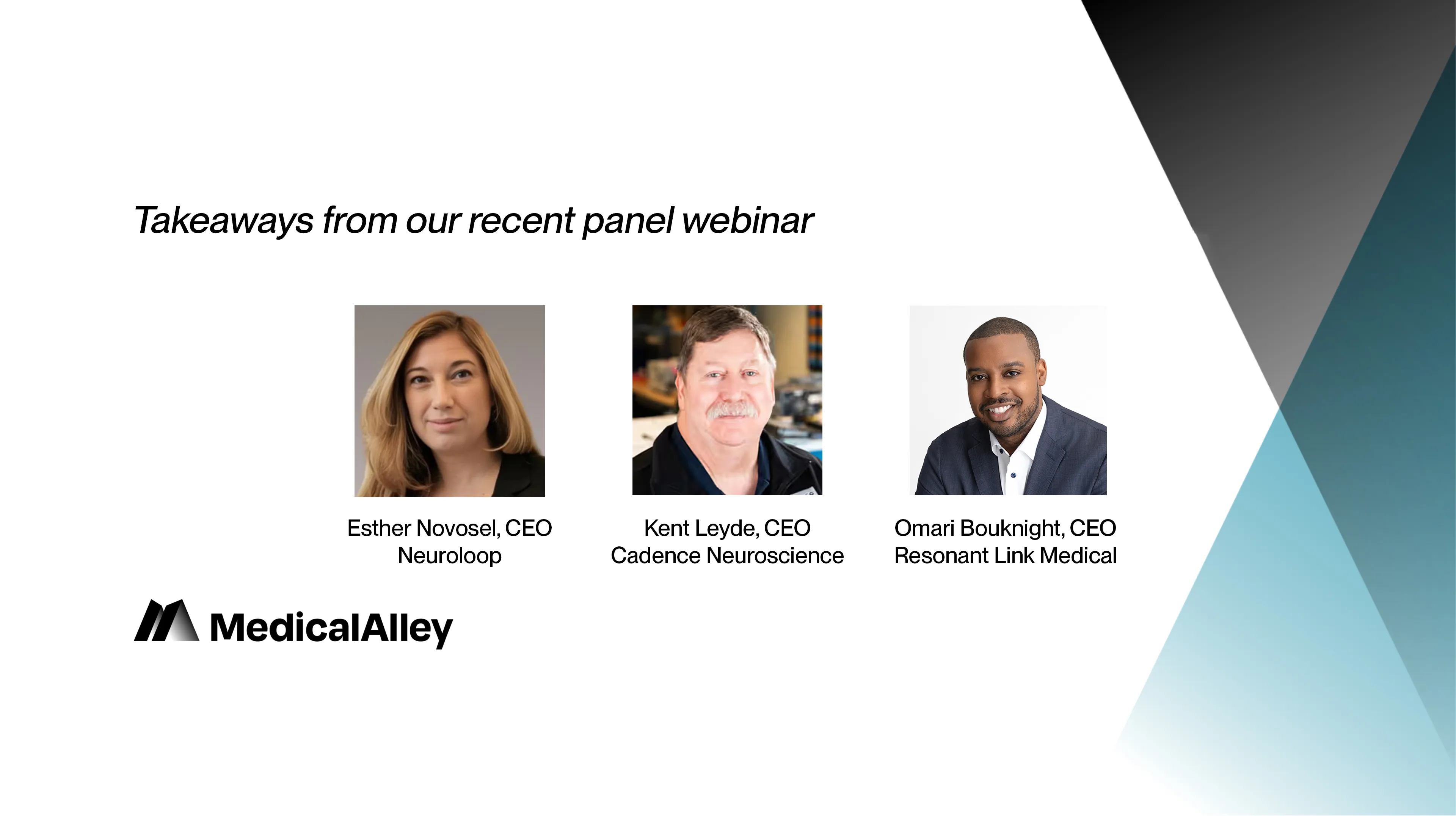
It's a question I had the opportunity to explore on a recent panel hosted by Medical Alley alongside two peers I deeply respect — Esther Novosel, CEO of Neuroloop, and Kent Leyde, CEO of Cadence Neuroscience. The theme of the conversation was "Old Ideas, New Innovations" — and the conversation stayed with me, because it gets to the heart of exactly why Resonant Link Medical exists.
The premise is this: some of the most important technologies in medicine aren't new. They've existed for years — sometimes a century or more. The real breakthroughs happen when someone stops accepting the limitations of the old approach and asks a fundamentally different question.
Wireless power is a perfect example. But so is the work Esther and Kent are doing. And together, I think their stories illustrate something important about where MedTech innovation actually comes from. And how we can nurture it.
If you missed the webinar, get the full replay here, or continue reading for my favorite moments.
The Tesla Problem — And the Question Nobody Was Asking
Nikola Tesla demonstrated more than a hundred years ago that you could wirelessly power a light bulb from a distance. The physics have been understood for over a century. And yet, a 2014 article in The Atlantic asked a question that stopped me cold: "Who killed the rechargeable pacemaker?" The answer wasn't that the idea was bad. It was that the approach hadn’t been disrupted.
Traditional induction-based wireless charging generated too much heat, forcing charging to be slow and impractical for implantable use. With little motivation to change the guidance and payers incentivized to continue the status quo of frequent battery replacement surgeries, the industry quietly moved on. Rechargeable implantables fell out of favor not because the concept failed, but because the patient experience failed. An unreliable, burdensome charger created a bad interaction and wrote off the whole category before it even got started. That insight shaped how we built Resonant Link Medical.
No innovation succeeds if it can’t be used in the real world, and if people won’t buy it — two core tenets to how we operate.
One of the core benefits of an implantable device is that it removes burden from the patient — no pill to remember, no schedule to follow. But that only works if the device itself is forgettable. The moment a patient has to spend their day managing a charger, you've just replaced one burden with another.
We believed there was a better way. By rethinking how current flows through the windings — specifically, by integrating capacitance to optimize energy transfer — we developed a fundamentally more efficient approach to wireless power that runs cool, charges fast, and works reliably at a distance. That became the foundation of our Aurion WPT™ platform — the only wireless technology platform combining patented innovations in coils, power electronics, magnetics, and data transfer into a single system built specifically for implantable medical devices.
Selectivity: The Question That Changed Everything at Neuroloop
Esther Novosel's company is doing something similar in a completely different domain — and her story makes the same point.
Vagus nerve stimulation was first FDA-approved in 1997. For nearly 30 years, the standard approach has been to wrap a bipolar silicone cuff electrode around the nerve and stimulate a broad surface. It works — but only partially.
Then Esther asked the question nobody had asked: should it work that way?
"The vagus nerve is a heterogeneous structure consisting of many fibers, each regulating different body functions," she explained during our conversation. "Does it really make sense to stimulate a huge surface of that nerve if you want to treat one specific indication in one specific patient?"
Once you ask that question, the answer is obvious. Of course it doesn't. But answering it required Neuroloop to develop an entirely new class of electrode — a 15-micron-thin, multi-channel cuff using photolithographic methods borrowed from semiconductor manufacturing — that can target a single defined point on the nerve.
They're now in clinical trials targeting resistant hypertension, and have recently achieved proof of concept for blocking the vagus nerve entirely — not just stimulating it. That expands the range of treatable conditions dramatically. A GLP study is expected this year.
The technology isn't new. The question is.
Challenging the Standard: Cadence Neuroscience's Approach
Kent Leyde has been in medical devices since the 1990s. His first startup, HeartStream, built the defibrillators that are now hanging on walls in airports and other public buildings across the country. And his core philosophy hasn't changed: find the assumptions nobody is questioning, and challenge them.
"I make it a habit early in any ideation cycle to search the space for assumptions that everyone is relying on without questioning them," Kent said. "If you don't challenge them, you just go off and make the same product again."
At HeartStream, the assumption was that a therapeutic defibrillation waveform had to be a specific shape — an assumption literally codified in the regulatory standards. When implantable cardiac defibrillator manufacturers, under severe size constraints, developed more efficient waveforms out of necessity, HeartStream applied the same logic to external defibrillators. The company built a bystander-accessible device that fit in an airport wall instead of a hospital cart.
Now, with Cadence Neuroscience and a therapy for drug-resistant epilepsy licensed from Mayo Clinic, Kent is applying the same discipline to the brain. He was refreshingly candid about where the field stands: "Our technologies are incredibly primitive relative to what's going on in the brain. We're doing the equivalent of trying to make a computer run faster by throwing a roll of coins into it."
That's not defeatism. That's the honest assessment of someone who has been in rooms where standard assumptions were successfully overturned, and who knows what it looks like when a field is still early.
We're Technology Recipients — And That's a Superpower
One of the points Kent made brilliantly: the people building the next generation of medical devices need to be students of what's happening outside their specific field, especially when it comes to technology. And it's a reason to rely on external partners who are experts in their respective areas.
In medical devices, we're often not the technology driver. We're the technology recipient. We didn't invent the transistor, but we sure use a lot of them...Moore's Law wasn't built in our field, but it applies to us."
The smartphone revolution, advances in miniaturized packaging, next-generation battery chemistry, computational modeling at scale — all of these are now becoming foundational capabilities for implantable medical devices. The question for device teams isn't whether these broader advances will affect your work. It's whether you're watching closely enough to know when they've crossed the threshold from interesting to applicable, and when they do, to know who to contact to help in that area.
At Resonant Link Medical, it's something we think about constantly as technology components advance our system capabilities as well. Our Aurion WPT™ platform has been designed into more than 50 types of implantable medical devices — from neuromodulation devices and brain-computer interfaces to ventricular assist and cardiac rhythm management devices — precisely because the underlying physics of high-efficiency, low-loss wireless power transfer applies across clinical applications. And we benefit from advances in materials, power electronics, telemetry, and more that originate well outside the walls of any single company — including ours.
AI, Data, and Precision: What Comes Next
The convergence of MedTech with the broader technology ecosystem is creating a new dimension of opportunity — one I find genuinely exciting.
Many clinical trials that failed to meet their primary endpoints weren't necessarily built on bad technology. They may have simply lacked the right predictive model. When you look at sub-patient group analyses, there's often a target population where the therapy worked remarkably well — but the trial was designed around a population too broad to show it.
What AI makes possible is more precise targeting, more accurate prediction, and ultimately more predictable clinical outcomes. That's not a small thing. It could unlock the potential of entire categories of technology that were written off as failures — not because the physics didn't work, but because the targeting wasn't right.
Esther described a similar dynamic from her perspective. The data that implantable devices generate could one day support prediction models that not just treat chronic conditions, but prevent acute events before they occur. That represents a fundamental shift — from reactive medicine to anticipatory medicine. Her team is already thinking about this architecture now, even at the clinical trial stage.
At Resonant Link Medical, we believe fast, reliable, wireless power and data transfer is a prerequisite for that future. Smaller devices mean more opportunities for less invasive, more precise placement. Faster, less frequent charging means better patient compliance and satisfaction. Continuous telemetry through the same wireless connection means richer, reliable data and communications. These capabilities aren't separate — they compound.
You can explore how we're enabling this across different therapeutic areas in our Resource Center.
Why So Many Promising Technologies Stall
The most practically useful portion of our conversation addressed a challenge every builder knows well: why do great technologies stall between proof of concept and patients?
I'd frame it around two questions: Is it possible? Is it predictable?
The early phase of any program is about showing it's possible — that your innovation can create a measurable positive effect. But the heavy lift is predictability. We're dealing with human beings who present differently based on genetics, age, body size, disease progression, and a hundred other variables. Showing what's possible in a controlled setting, and then showing that it's predictable across a heterogeneous population — those are very different mountains.
Esther added a dimension specific to the regulatory landscape in Europe that I think resonates universally: Neuroloop was founded nearly 10 years ago, before the EU Medical Device Regulation (MDR) existed. The regulatory environment they're operating in today looks nothing like the one they started in. When you're developing a Class III fully implantable active medical device, decisions made at the preclinical stage can lock you in for years — even if the world changes around you.
"Everything changes between proof of concept and market," she said. "And if you make a design decision too early that you can't change later, you're married to it."
We see this with power architecture decisions all the time. Device teams sometimes make choices early in development that become nearly impossible to revisit later — even when better options become available. It's one of the reasons we offer our Feasibility Study early in the design process: to give teams a clear-eyed view of how power can enable enhanced device capabilities before decisions become permanent and they realize they missed out.
Advice for Innovators: Design for Tomorrow
When the conversation turned to advice for innovators, I said something I believe deeply:
"The decisions you take today, you'll have to live with tomorrow. While it's convenient to design for today, you need to think about designing for tomorrow. A lot of innovators delude themselves into thinking 'I'll tweak this later' — but as soon as certain decisions become part of your design file, you're married to them for years."
Esther's advice was equally direct: stay with your vision, be curious, do things differently even when it's the harder path, and be ready to fail — then retry, and have a long breath.
And Kent reminded us that we don’t have to do it alone: don't be shy about your network. If you're stuck on a problem, find the world's expert on that specific issue and call them. More often than you'd think, they'll pick up the phone. People in this field want to help other people in this field. Don't go it alone.
The Bigger Picture
At the end of our conversation, Kent shared a story. Shortly after the HeartStream defibrillator launched, a man collapsed at Grand Central Station in New York City. Responders used one of the newly-delivered defibrillators. He was resuscitated. Kent got to meet him later — and meet his family, and his kids.
"If you've been in medical devices for a while," Kent said, "I really hope you have that kind of experience — because it will forever change you."
That's why we challenge old assumptions. That's why we ask different questions about technologies that have existed for decades. That's why we push past the frustrating, slow, expensive middle ground between proof of concept and market. Not because it's easy. Because someone, somewhere, needs a device that doesn't exist yet — and we have the tools, the knowledge, and the opportunity to build it. We may even be able to see something someone who came before us couldn’t.
And that’s the beauty of innovation. Whether the idea is brand new, or simply new to us, the impact could be just as transformative.
Unlock the Full Potential of Your Device
Starting developing on your next gen device? Get in touch directly — we'd love to talk.
You can also explore our Aurion WPT™ platform, learn about our Feasibility Study process, or browse our Resource Center to learn what’s worked for dozens of teams building smaller, smarter, and longer lasting implantables.
by Omari Bouknight, CEO of Resonant Link Medical