
Derisk your path to the best power with the tools, technology, and team built for implantables
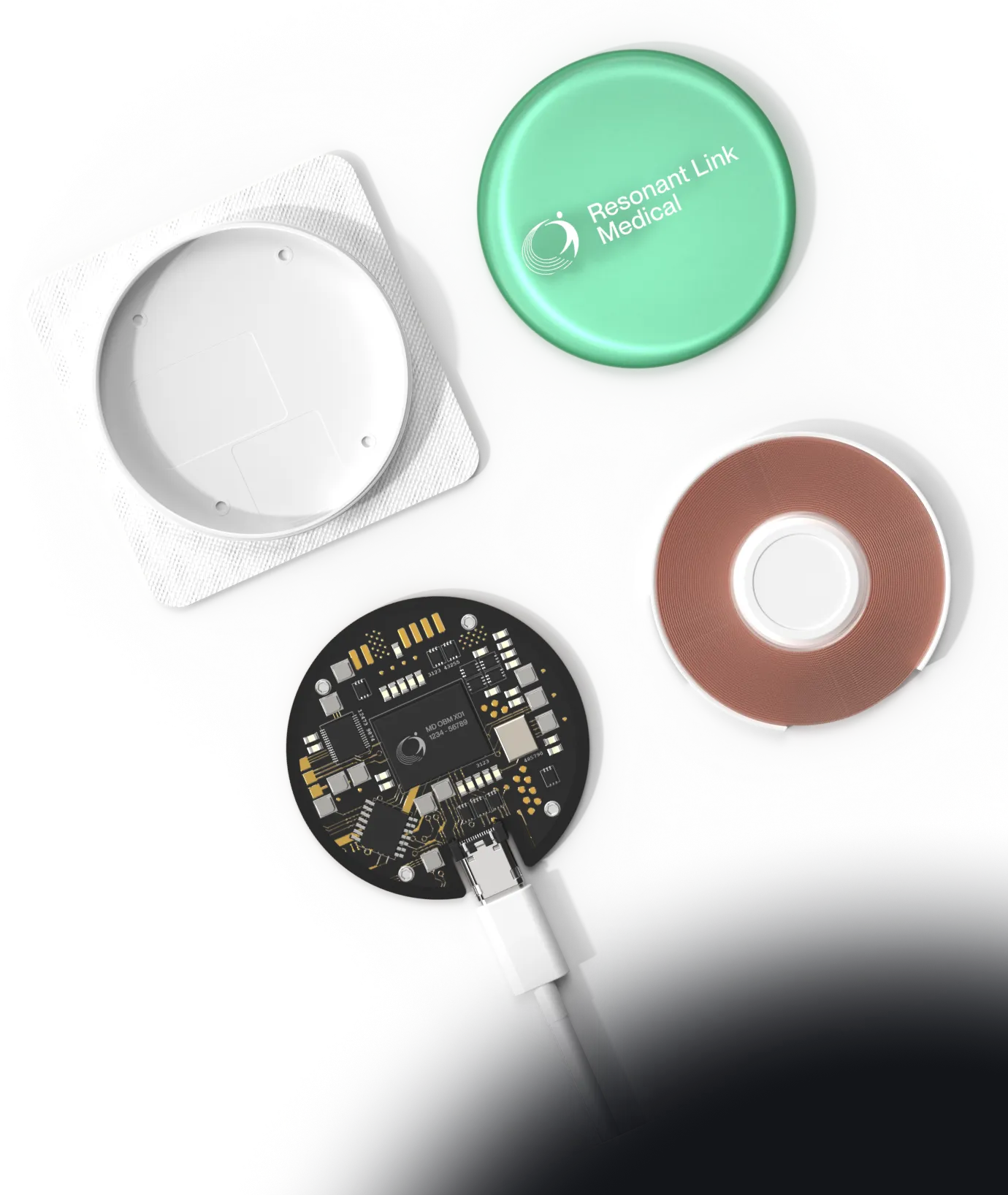
A proven technology platform, adapted to your device and clinical needs
10x
10x faster wireless charging to recharge in minutes, not hours
1
1 design iteration from
feasibility to preclinical
50+
50+ device types designed
with our wireless power

Not sure wireless power will work for your application?
Frequently asked questions
Contact Us
Resonant Link Medical is an innovative medical technology company redefining wireless power and data transfer for implantable medical devices to help people get well and stay well. Its Aurion WPT™ wireless power has been designed into more than 50 different types of implantable devices across neuromodulation, cardiac rhythm management, brain-computer interfaces, circulatory assist, sleep apnea, smart orthopaedics, and other clinical areas.
Resonant Link Medical is solving the fundamental challenge of powering implantable medical devices safely, reliably, and conveniently to deliver more effective and accessible treatments for people living with health conditions such as chronic pain, epilepsy, depression, sleep apnea, and heart failure. Today, patients face repeated surgeries to replace depleted batteries or live with bulky, inconvenient charging systems that restrict their quality of life. Resonant Link Medical eliminates these trade-offs with its industry-leading wireless technology platform Aurion WPT™ — enabling smaller, smarter, and longer lasting devices that improve patient care.
We have been working on implantable power since 2013 when, while at Dartmouth College, our co-founders invented a new way to send power wirelessly that was much more precise and generated much less heat than prior wireless power transfer methods. They called this breakthrough wireless power coil technology the multi-layer self-resonant structure or MSRS, and formed a company around it in 2017. Nearly a decade later, Resonant Link Medical is a medical technology company that’s 100% focused on wireless power and data solutions for medical devices.
What makes Resonant Link Medical unique is a combination of our proven implantable power products, backed by nearly two dozen patents spanning every area of wireless power technology, our design and development framework and tools that ensure a smooth integration process, and our team that consists of the leading minds in implantable power. Wireless implantable power isn’t new; the products that deliver on its promise are.
Resonant Link Medical's Vivigo™ 20-Minute Universal Charger can recharge a 440 mAh implantable battery in approximately 20 minutes, 10 times faster than conventional wireless charging. This speed is achieved over a large charge range, with 6 cm of misalignment and implant depths up to 6 cm, so patients are free to move while they recharge and charging works deep in the body, unlike conventional chargers. Faster, infrequent charging improves patient compliance, reduces the burden of managing a chronic implant, and increases adoption of implantable therapies.
Even with the capability to recharge in minutes, rather than hours, not every customer of ours chooses to charge this fast. With the Vivigo™ platform’s underlying Aurion WPT™ technology, you can apply the performance gains to other specifications like further increasing the charge range or decreasing size. That means, whatever high performance means to you, we can help you achieve it.
Resonant Link Medical specializes in wireless charging and power solutions for implantable medical devices. In addition to being the implantable power experts, Resonant Link Medical has developed power solutions for other health applications, such as wearables and devices for veterinary applications. Contact us to discuss your specific device.
If you’d like to work together, or aren’t sure but are considering it, the best place to start is a conversation with our team. We work closely with implantable device companies from early feasibility through commercialization, and the right entry point depends on where you are in your development journey.
That said, it’s never too early to have a conversation as companies we talk to almost always tell us they wish they’d known about us sooner. When power is considered early in design and derisked early in a company trajectory, it becomes an unlock that leads to new capabilities. When it’s considered late, it becomes a limitation, unnecessarily restricting innovation.
We'd recommend reaching out to schedule a technical discovery call so we can understand your device, requirements, clinical milestones, and timeline. From there, we can identify the best product platform for your needs and discuss what a partnership looks like. Contact us to start that conversation.
Our team brings expertise at every stage, from early concept through design verification testing, serving as your fractional power team so you can be confident power is handled.
We’re the only company solely focused on wireless power transfer for implantable medical devices, our multiple product platforms derisk and accelerate your development, and our proven processes support you from concept to commercialization.
On the technical side, when wireless power and charging for implantables is all you do, that shows up in thermal performance, regulatory documentation, and how deeply we engage with your team. Because we work from established product platforms rather than bespoke designs, we’re not handing you a map and walking away. You get known, proven components with predictable performance characteristics, all backed by clear, submission-ready documentation. That means faster development, a straight path to verification and validation, and no surprises. We’ve seen and solved the hard problems before you encounter them, and we’re invested in how your device performs long-term.
No, we're different from a traditional contract development and manufacturing organization (CDMO). We operate as your fractional wireless power team and you maintain full control of production with the ability to partner with a CDMO for production or manufacture yourself. We have the processes in place to ensure a smooth handoff to any partners with whom you choose to work.
Our current product platforms support wirelessly powering implants up to 6 cm beneath the skin surface, enabling treatment of a wider range of body types and anatomical locations than shallower conventional charger systems allow. With further tradeoffs, implant depths can be extended even more. Our Aurion WPT™ wireless technology also maintains power transfer with a large range of lateral and angular misalignment between the implant and the external charger, meaning patients can move freely while charging and device teams and clinicians can have confidence in patient compliance.
Our Aurion WPT™ wireless technology currently supports a wireless power transfer range of up to 6 cm, with additional distance possible with customization.
Efficiency is highly variable between wireless chargers, and most of our customers actually optimize for lower implant heating instead of overall end-to-end efficiency. Our power products are specifically built to move losses from the implant into the external hub through loss balancing and system optimization, so performance is characterized across a range of variables. That said, many of our Vivigo-based systems are more than 75% efficient at implant depths of multiple centimeters, providing an ideal balance of efficiency and charge range.
Charger size is application-dependent and customizable. Implant coil sizes have been as small as 3 mm in diameter and as thin as 400 microns.
MSRS coils can be made from a range of non-exotic, commonly available materials. The same applies with all components used in our wireless power system designs. Using materials that are well-understood and widely available keeps costs down, simplifies manufacturing, and means you're not building supply chain risk into your device before it even gets to market.
Biocompatibility, MRI compatibility, and other constraints all factor into component and material selection. We'll model different options against your specific requirements to find something that meets all of your goals, not just your performance goals. Because we know the best power solution in the world only matters if patients can use it and teams can build it, reliably and cost-effectively, at scale.
Our wireless power systems are designed to work with all rechargeable battery types, so you're not locked into a specific chemistry or supplier. That said, the battery you choose can have a meaningful impact on performance, and we can advise you on what will work best depending on your goals. Whether you're optimizing for miniaturization, faster charge times, reduced patient charge burden, or something else, we can point you toward the battery companies and chemistries best suited to get you there.
Yes! Many of our chargers are MRI-compatible. There are performance tradeoffs with each requirement and we work with customers to highlight the tradeoffs and alternative approaches. Our Vivigo™ 20-Minute Universal Charger is compatible with titanium-encased implantable medical devices and is also MRI-compatible.
Yes, and we go well beyond just meeting them. SAR is a core part of our design process that we track in every phase of our program, not something we wait to check at the end. We've designed high-performance wireless power within SAR constraints across more than 50 different types of implantable devices, so we know how to get the most out of a system while staying comfortably within limits. It's one of the areas where our depth of experience really shows up.
Most of our chargers operate at an ISM band with an operating frequency such as 6.78 MHz so they can be used globally in compliance with the FCC and other RF governing bodies. However, frequency can be customized and we have experience designing chargers at a wide range of frequencies.
Our goal is to reduce the technical, compliance, and commercial risks associated with integrating wireless power into your medical device, helping minimize regulatory effort, cost, and time to market.
The level of support depends on two factors: whether your program is based on one of our existing platforms or a fully customized solution, and the level of regulatory assistance your team requires.
Our platform-based solutions are built on mature hardware that has undergone preliminary verification against key medical device standards, including electrical safety, EMC, and usability, and has been developed with risk management in mind. Customers receive core technical documentation, including a Product Requirements Document (PRD) and wireless power verification test plans and reports.
For programs requiring additional support, we can perform application-specific verification activities such as EMC/immunity, thermal, and environmental testing, providing the associated test plans, protocols, and reports. We also support the development of risk management documentation, including hazard analyses and DFMEAs, and can tailor verification activities from early compliance de-risking through regulatory submission.
Fully customized solutions benefit from the same proven design principles and regulatory experience, although the increased level of customization may require additional verification. Regardless of the engagement model, our team can provide practical regulatory feedback throughout your development journey.
Yes, our wireless power systems are currently in use in IDE-approved human trials.
No. Our technology is not limited to Class III devices. We work with customers developing a range of medical devices and tailor our solution to their specific power, clinical, and regulatory requirements. That said, Class III is where our Aurion WPT platform delivers the most meaningful impact. These are the devices where the stakes are highest — where thermal management, clinician workflow, patient experience, and regulatory scrutiny are most demanding, and where the margin for error is smallest.
Aurion WPT™ was purpose-built to meet the challenges of Class III devices, offering a way for medical device teams to get to market faster with the power their device needs to increase patient adoption, compliance, and satisfaction.
A few companies offer wireless power components that can be adapted for medical use, and some device teams go through contract manufacturers who bundle charging as part of a broader build. The difference with Resonant Link Medical is that wireless power and charging for implantables is all we do. That shows up in thermal performance, regulatory documentation, and how deeply we engage with your team. We're not handing you a component and walking away. We're your fractional power partner who uses proven products and processes to ensure you get your next-generation device to market faster and with less risk, and we’re invested in how that device performs long-term. What frustrates us most is we’ve had customers come to us after other companies failed to deliver a viable power solution for them, and they’ve lost millions of dollars and years of effort as a result. We don’t want that to happen to anyone.